
A photo-finish strip shows you exactly when every runner crossed. It does not tell you who. In a lane heat that gap has a name: each crossing has to be tagged with a lane before it becomes a result, and deciding which lane a shape belongs to is the part of adjudication that actually takes time.
Meanwhile, someone at the finish already knows. The field judge calls the lanes across the line as they cross, out loud, in real time. Called finishing order is simply writing those calls down so the person marking the strip does not have to work out the same answer a second time.
The effect is that one job becomes two smaller jobs running in parallel: one operator supplies the order, the other supplies the times, and neither waits on the other.
What it changes, concretely
Without calls, marking a lane heat is a two-step loop for every runner: scrub to the crossing, then pick the lane it belongs to. Picking the lane is the expensive step, because it means reading the picture, or remembering the finish, or asking someone.
With calls recorded, the lane rail on the marking screen is already in the order the lanes crossed, and Mark walks along it by itself. The loop collapses to: scrub to the crossing, tap Mark. The lane is never chosen at all.
That is the whole feature. Everything below is how to work it, how to fix a call that was wrong, and where it stops.
Who does what
Two positions, both of which already exist in a photo-finish crew.
| Position | Device | Job |
|---|---|---|
| Bib Collector | In the chute, near the judge | Taps each lane as it is called |
| Capture | The mounted camera | Marks the crossings on the strip |
This is a good fit for the Bib Collector precisely because a lane heat leaves that position with the least to do. Bibs were assigned to lanes before the gun, so there is often nothing to type. The calling pad gives that operator the job that is genuinely urgent while the race is running, and the bib work is still there afterward when it is not. See roles and responsibilities for how the two photo-finish sub-roles split.
The collector does not have to be a separate person from the judge. If the judge is holding the phone, they are calling and recording in one motion.
Recording the calls
On the Bib Collector, a lane heat opens on a Call order / Bibs segment, showing Call order. That is deliberate: the calls are what is outstanding at that moment.
The pad is one large button per lane, in lane order. Tap each lane as the judge calls it.
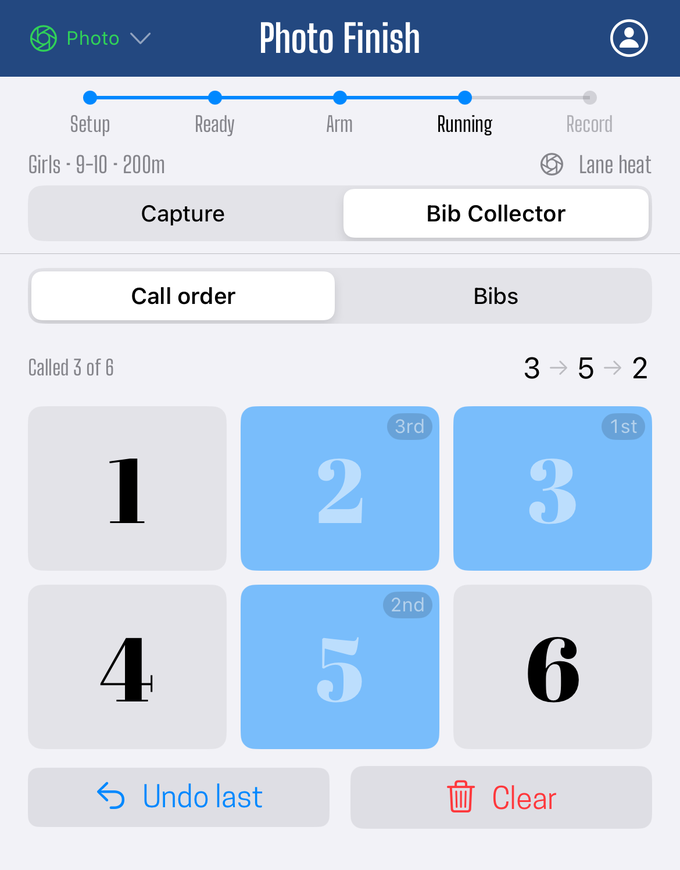
- A called lane fills in and picks up a badge with its position:
1st,2nd,3rd. - The buttons never move. The pad stays in lane order all the way through the heat, so your thumb can find lane 5 without looking at the screen.
- A lane already called does nothing when tapped again. A lane heat records one crossing per lane, so a second tap is a mis-hit, and treating it as one is the safe reading.
- The running sequence sits above the pad, most recent call at the right.
Two corrections are available:
- Undo last removes the most recent call. This is the one to reach for mid-heat, because it does not require reading anything.
- Clear starts the sequence over, behind a confirmation. Use it between heats, not during one.
The whole field is normally called before the camera operator opens the strip at all. Calling six lanes takes a few seconds and happens while the runners are still slowing down, so by the time anybody is marking, the sequence is complete.
Once the heat leaves timing and moves into recording, which is what your own Submit does, the pad goes read-only and the screen moves over to Bibs. From that point the calls are a record of what happened, and a mistake in them gets fixed on the strip rather than here.
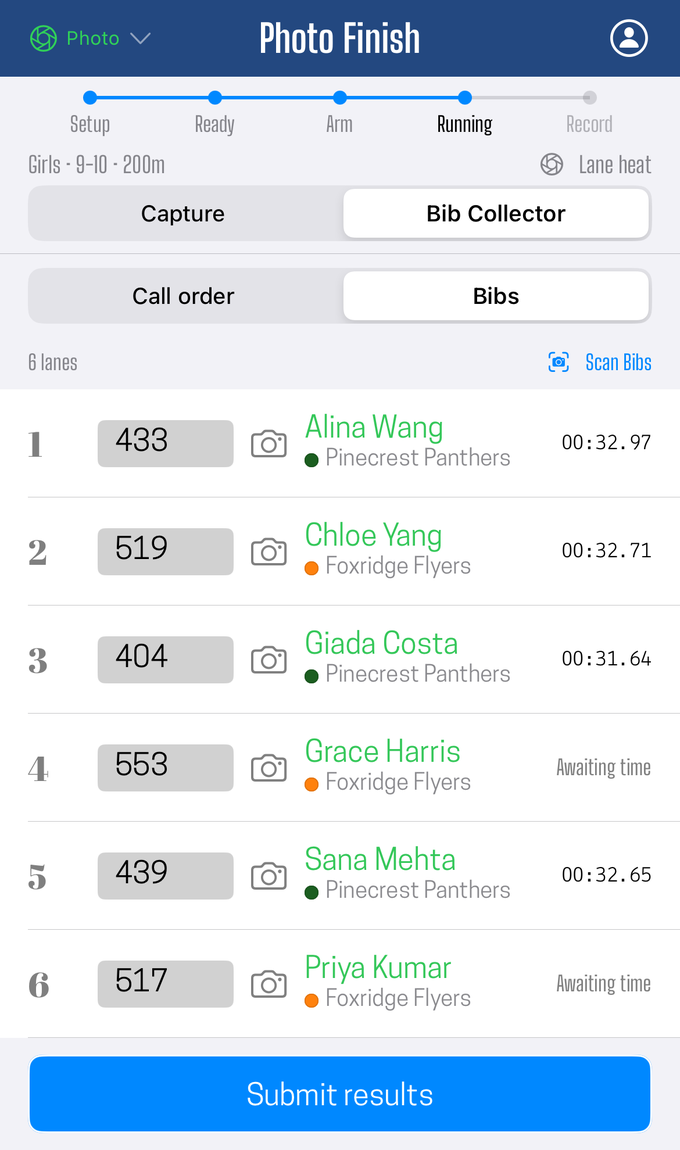
Marking with the calls
Nothing has to be turned on at the camera. When calls exist, the marking screen picks them up on its own.
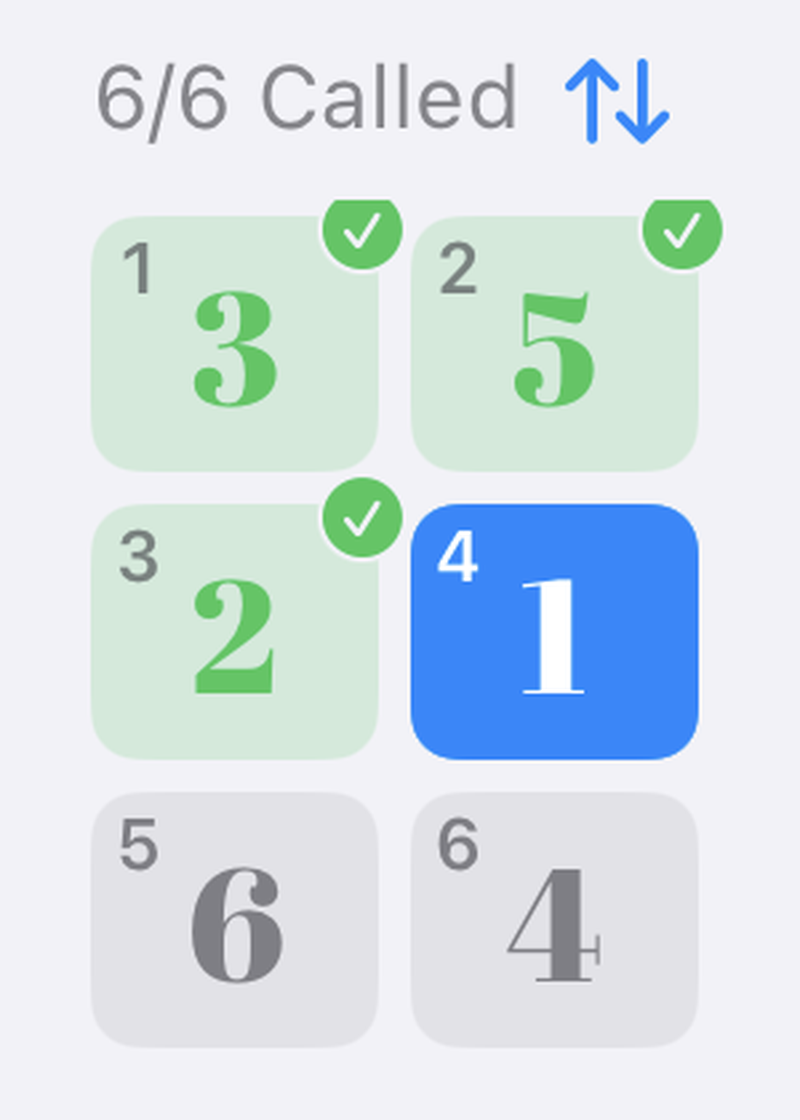
- The lane rail sorts into the called order. Called lanes come first in the order they crossed, then anything uncalled by lane number.
- The rail heading reads
n/m Calledinstead ofn/m Lanes, which is how you know the buttons are no longer in lane sequence. - Each chip carries its call position, so the order is still readable after you have scrolled the rail. A green tick marks a lane that already has a crossing.
- Mark auto-advances along the called order. Scrub to the first crossing, tap Mark, scrub to the next, tap Mark. Each mark lands on the lane the judge called for that position.
A lane picked by hand always wins. The calls order the rail and preselect the next lane; they never overrule a choice you made.
When the judge got it wrong
A close finish is exactly where calling by eye is hardest, and the calls can simply be wrong. Suppose
the judge called 3-5-2-1-6-4 and the picture shows the real order was 3-5-1-2-6-4, because lanes
1 and 2 could not be separated from the side of the track.
Marking straight through gives you six correct times with two crossings carrying each other's lane. Nothing on the strip is wrong except the labels.
Tap the reorder control beside the rail heading. It is the small up-and-down arrows next to
n/m Called in the figure above, and it is always there on a lane heat.
That opens the sequence as a row of draggable lane markers. Press and hold one and slide it to where it belongs, then Apply. The marks re-tag themselves from the corrected sequence: the earliest crossing takes the first lane, the second-earliest the second, and so on down the strip.
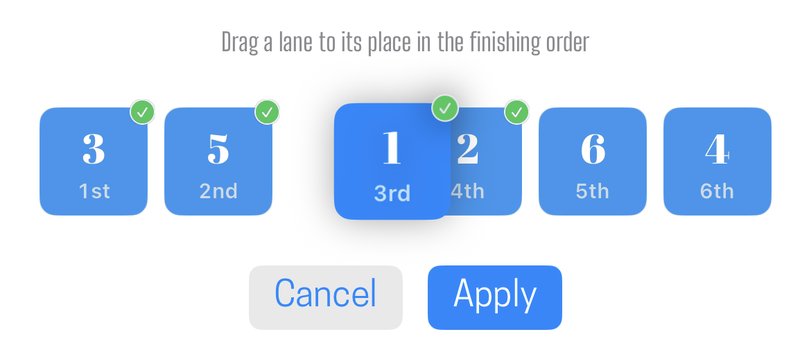
The marker you are holding lifts and follows your finger; the rest slide aside to make room, and the position labels underneath update as you go, so the sequence you can read is the one that will be applied.
Three things worth knowing about it:
- The corrected order is published. It replaces the judge's on every device, and it travels with the strip, so a record keeper re-marking this heat next week gets the right sequence rather than the original call.
- The times never move. Reordering changes only which lane is attached to each crossing.
- Applying without changing anything is safe. The editor opens on the order currently in force, so confirming it as-is leaves your marks exactly where they were.
It also repairs a set marked out of time sequence, where every crossing is on the picture but the tags are rotated against the times. That happens when you read the tight finish at the front first, or when a record keeper re-marks the strip from scratch. Open the editor, apply, done.
What it does not do
- It never adds or removes a mark. Reordering only shuffles the lanes among the crossings you already marked. The same set of lanes goes in and comes out.
- It does not resolve a real disagreement. If the calls name lanes 1, 2 and 3 but the strip was marked on 4, 5 and 6, the lanes the two have in common are reordered and the rest are left alone. Deciding who actually crossed is the operator's call, and the app will not guess it for you.
- It is not a source of times. A call records order, never a moment. Every time in the heat still comes off the strip.
- It does nothing in a pack heat. A pack has no lanes to call, and its crossings are already ordered by the times they were marked at. The pad does not appear.
- It is entirely optional. A heat with no calls recorded behaves exactly as it did before the feature existed: the rail is in lane order and you pick each lane yourself. The reorder control is still there, so the marking operator can set the order even when nobody called it.
Where the calls survive to
The sequence is kept in three places, so it is still there when you need it later:
- On every device that saw it, including through an app relaunch mid-heat.
- With the record keeper, for a re-mark on their own device.
- With the strip itself, so a record keeper reviewing that strip days later gets the calls with it, long after the device that recorded them has left the meet.
Where it keeps the meet moving
The saving on a single heat is small. It adds up where heats come close together.
Sprints, where heats run back to back. A round of 100m heats is the tightest stretch on most schedules: small fields, short races, and the next heat at the line while the last one is still being read. Any one strip takes a moment to mark, but there are a lot of them in a row, and the camera is the one finish position that cannot work ahead of the track. Taking the lane-tagging step out of eight heats in a round adds up to more than taking it out of a single 3200m.
Marking that slips a heat behind does not announce itself. Nothing on screen looks wrong, and the usual first sign is a question from the record keeper about a heat two events back, where a lane that was never marked and a lane that has not been read yet look the same. Calls keep the marking inside the gap between heats, which is where it stays out of the schedule's way.
Any other lane heat. Anywhere the finish is close enough that reading lanes off the strip takes a second look.
A heat without calls costs nothing. It behaves exactly as it always has, so an operator needed elsewhere for one heat can leave the pad alone and pick it up on the next. There is nothing to switch on or off, and no state to reset between heats.
Call every lane, every lane heat. It takes a few seconds while the field is still slowing down, and it costs nothing on the heats that turn out to be easy. Whether a finish was close is only known once it has happened, and the calls can only be recorded while it is happening.
Did this answer your question? If something here is wrong, missing, or out of date, tell us at support@finishlinetimer.com and we’ll fix it.