
The starter owns one thing: the gun. Bring a staged heat to the line, then fire it. That is the whole job, and it is deliberately narrow, because it is the only job in the meet where being a fraction of a second late actually costs something.
Where the starter sits
Everyone at the start joins in the Starting Line role and picks a function:
- Staging builds the heats.
- Starter arms and fires them.
One person can do both by flipping the selector, which is normal at a small meet. At a busy meet they are two people on two devices: the staging person works the chute, the starter works the line, and neither waits on the other.
The starter never edits rosters, and staging never fires the gun.
Arming, and why only one heat at a time
The starter takes the heats staging has sent out in the order they were sent, and arms the one at the front. There is nothing to choose from: the starter's screen shows the front heat and only the front heat, so the order staging sends them in is the order they go off. Arming means this heat is on the line with blocks in, waiting for the gun.
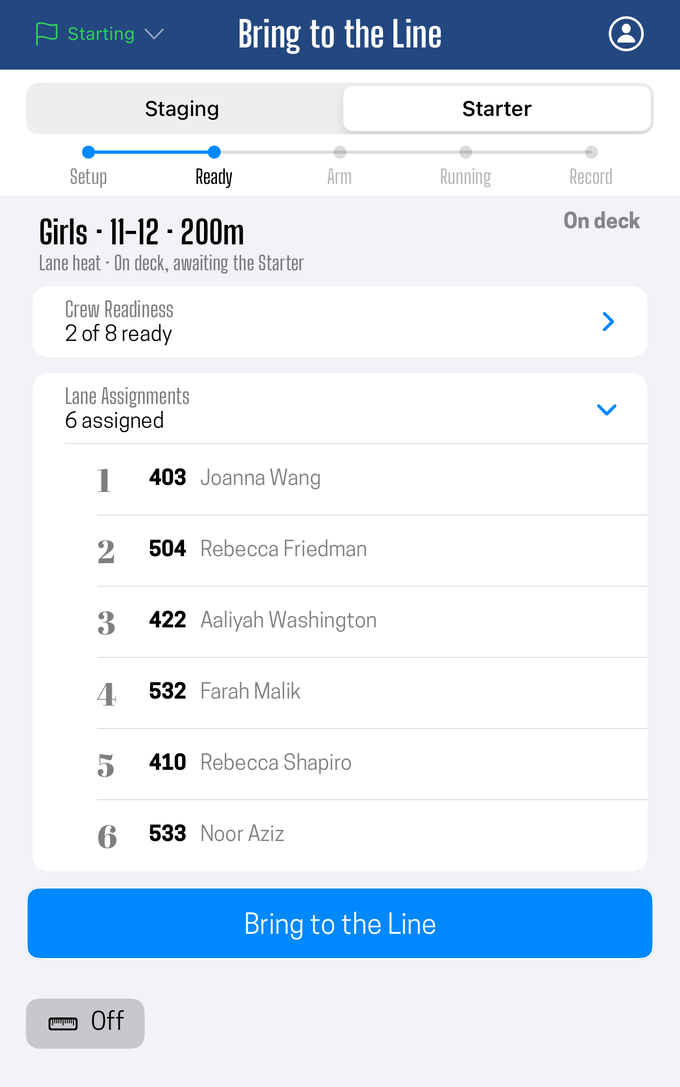
Only one heat can be armed at a time. That is not an arbitrary restriction: it is how the app knows which heat a gunshot belongs to. There is one starter and one gun, so there is one armed heat, and whatever the gun does next belongs to it. Once it fires, that heat moves to running and the next can come to the line.
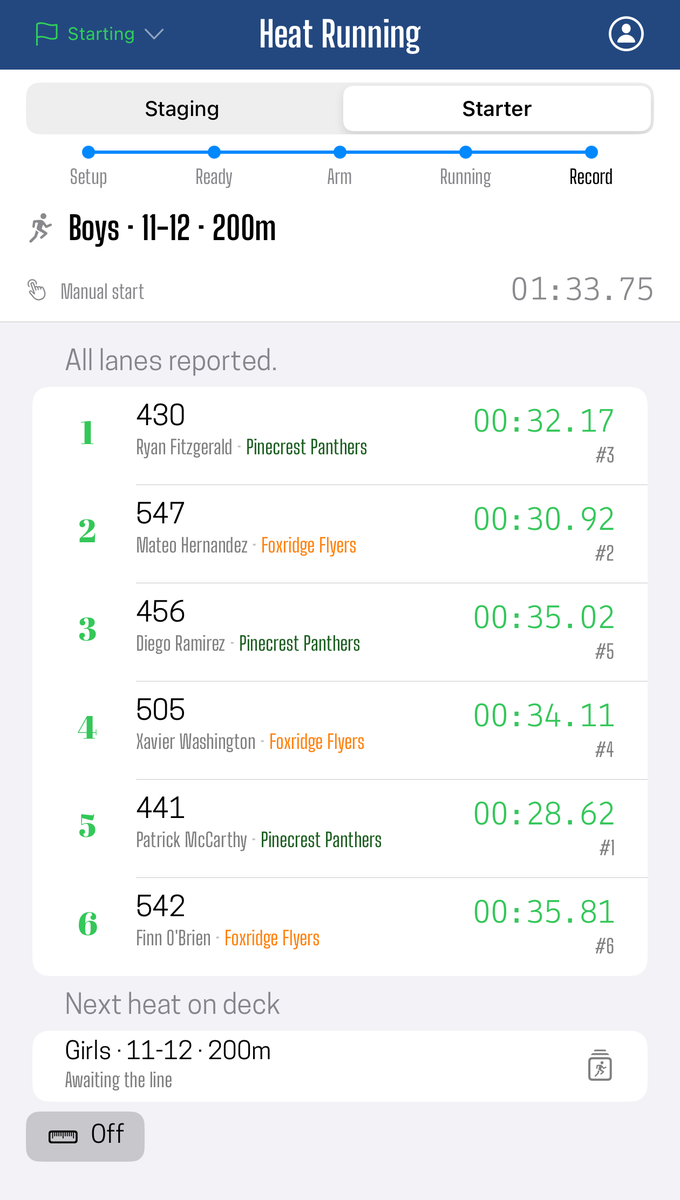
More than one heat can be running at once, which covers a distance race still on the track while a sprint goes off. The app does not cap how many, so the ceiling is whatever the start crew can keep straight. Past two, knowing which gun started which heat stops being reliable.
Firing
Two ways, always both available:
Tap to start. The manual button. Always present, always works.
Automatic detection. When the acoustic start is on, the device listens for the gun while the heat is armed, and fires on the sound itself.
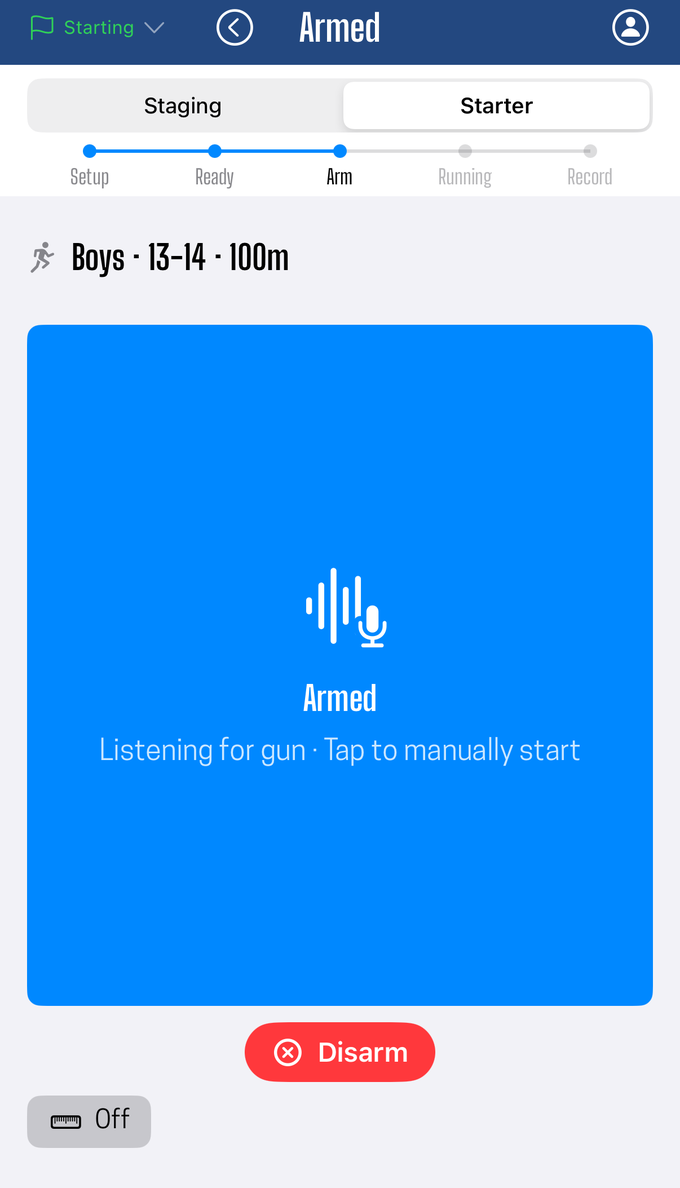
Detection listens only while a heat is armed. It is not sitting open through the meet, which both saves battery and means a stray bang between heats cannot start anything.
What automatic detection actually buys you
Not milliseconds of precision. It takes a person out from between the gun and the clock.
When someone hears a gun and presses a button, roughly 150 to 250 milliseconds pass, and that delay varies shot to shot. Every time in the heat carries it. That is far larger than any other error in the meet, and no amount of clock accuracy makes up for it.
When the device hears the gun, that delay is gone. The recorded start is the sound itself.
This is the single largest accuracy gain available at a phone-timed meet, which is why it is worth the small amount of setup. The full mechanism is in how the acoustic start works.
The cancel window
A detected start is not sent out immediately. It is held for a few seconds, with a countdown and a large Cancel Auto-Start button, while the clock runs in the meantime.
If you do nothing, it goes through. If you cancel, it is thrown out and the device goes back to listening.
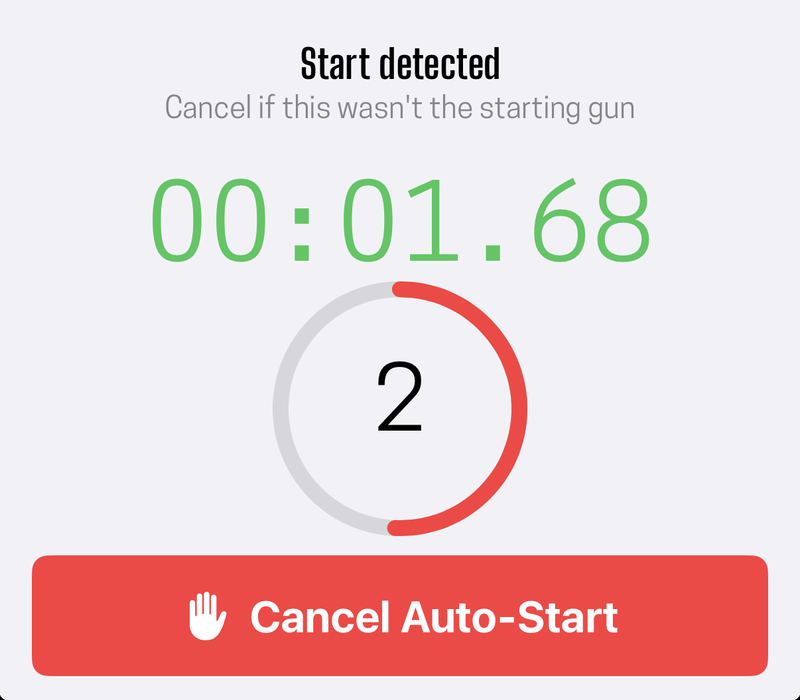
The hold costs you nothing. When the start goes through, it goes through with the instant the sound arrived, not the moment the countdown ran out. Those few seconds give you a chance to reject a bad detection without paying for it in accuracy.
Note that this is not a false start. A false start is a runner leaving early on a gun that really fired. This is aborting a detection that may not have been the gun at all.
When detection does not fire
It is tuned to miss rather than to guess. When it is not sure enough, it stays quiet and waits for you.
That is deliberate. A missed detection costs you one manual tap, and you were going to be standing there anyway. A false detection starts a race that has not started, and there is no clean way back from that.
So if the gun sounds and nothing happens, just tap. Do not wait on the app.
If the starter is not there
The starter is not a required position. If no device is ready as the starter when a heat goes, the finish operators can start it themselves, and the official gun time is worked out from their taps.
This follows the rule the whole app is built on: the app never has to be ready before a race can happen.
Practical notes
- Distance to the gun matters if it is large. Sound travels about 3 milliseconds per meter, so a phone 30 meters from the starter hears the shot roughly 90 milliseconds late. There is an optional correction for this, off by default; it only matters when the listening device is far from the gun.
- Point the device at the starter and keep it steady. Wind, and the sound of the phone being handled, are what it has to hear through.
- A pistol is the easiest source to detect. An electronic start through speakers or an air horn is louder but rises more slowly, which is harder, not easier. Calibrating helps.
- Check the gun is actually being heard before the meet rather than during it. Calibration is the place to do that.
Did this answer your question? If something here is wrong, missing, or out of date, tell us at support@finishlinetimer.com and we’ll fix it.